

The relationship between an addicted person and a codependent person is often described as a strong, intense bond that is “hard to understand” for those on the outside. On the surface, it may seem like a relationship based on care, loyalty, and sacrifice. Deep down, however, it can become a complex psychological mechanism that keeps both people trapped in an emotional vicious cycle. It is not about a lack of love, but about unhealthy patterns of relating that feed each other.
How the dynamic begins
Usually, the relationship does not start out as toxic. The codependent person is often empathetic, responsible, and willing to help. The addicted person may be charismatic, sensitive, or vulnerable. At first, one person’s care and the other person’s need seem to fit perfectly. One offers support, the other receives it. The problem appears when this exchange becomes the identity of the relationship.
Over time, the addicted person begins to rely more and more on the other for emotional regulation, managing consequences, and avoiding responsibility. The codependent person, in turn, begins to feel valuable only when they are saving, fixing, or supporting. In this way, the roles become fixed: one needs, the other needs to be needed.
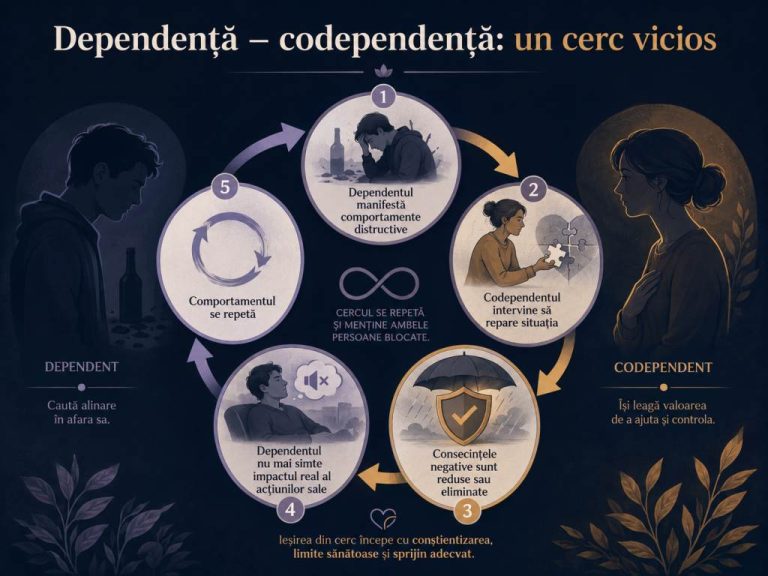
The mechanism of a vicious cycle
The cycle works in a simple but profound way:
- The addicted person displays destructive behaviors.
- The codependent person intervenes to fix the situation.
- The negative consequences are reduced or eliminated.
- The addicted person no longer feels the real impact of their actions.
- The behavior repeats.
Without realizing it, the codependent person becomes a buffer against reality. The intention is love. The result is the maintenance of the problem. The more the codependent person tries to control the situation, the less responsibility the addicted person takes. The more unstable the addicted person becomes, the stronger the codependent person feels the need to intervene.
In this way, both come to believe that they cannot function without each other.
The illusions that keep them stuck
Every toxic dynamic survives through mistaken beliefs. In this type of relationship, several powerful illusions often appear:
- “If I love him enough, he will change.”
- “Without me, he would completely destroy himself.”
- “If she didn’t pressure me, I wouldn’t need the addiction.”
- “The problem is your reaction, not my behavior.”
These beliefs shift responsibility away from oneself and onto the other person. Instead of each person looking at their own choices, both come to believe that the solution depends on the partner changing. This is one of the most subtle traps: the fight for control instead of personal responsibility.
The emotional costs
In the long term, this relationship erodes the identity of both partners.
The addicted person loses confidence in their own ability to cope with life. They become used to being rescued and end up avoiding confrontation with themselves.
The codependent person loses their personal identity. They live through the other person’s life, ignore their own needs, and become emotionally exhausted.
The paradox is that both suffer, but each believes the other is the cause of their suffering. In reality, the cause is the relational pattern.
Why abstinence alone is not enough
In many situations, when the addicted person gives up the substance or behavior, those around them believe the problem has been solved. But if the relational dynamic remains unchanged, the pattern reappears in another form: excessive control, anxiety, jealousy, the need for validation, or other emotional dependencies.
Abstinence treats the symptom. Inner healing treats the cause.
Without personal transformation, the addicted person may remain emotionally dependent, and the codependent person may unconsciously look for another person to “save.” That is why real recovery is not only an individual process, but a parallel one: each person must work on themselves.
What healing means for each person
For the addicted person, healing means:
- taking responsibility for their choices
- developing tolerance for emotional discomfort
- building an identity beyond addiction
For the codependent person, healing means:
- setting healthy boundaries
- letting go of control over the other person
- reconnecting with their own needs and values
Notice the difference: neither can heal the other. Each must do their own inner work.
The turning point
Change begins when one of them breaks the pattern. Not through blame, pressure, or threats, but through a change in inner positioning. When the codependent person stops rescuing, the addicted person faces reality for the first time. When the addicted person takes responsibility, the codependent person no longer has to control.
This is the moment when the vicious cycle begins to unravel.
Real hope
The good news is that these dynamics are not life sentences. They are learned patterns — and what is learned can also be unlearned. With the right support, awareness, and guidance, relationships can be rebuilt on healthier foundations: personal responsibility, clear boundaries, and mutual respect.
Healing does not necessarily mean separation. It means transformation. Sometimes together, sometimes separately. But always authentically.